
In this series of posts, I plan to discuss the musical ideas that go into my musical miniatures—brief, concentrated works that distill compositional thought into compact forms. These pieces often last only a minute or so, but within that short time, I aim to explore specific ideas in harmony, structure, and texture.
My harmonic language, which leans toward the dissonant and chromatic, is well-suited to this format. Extended stretches of sharp dissonance can be overwhelming in longer pieces, but when confined to miniature form, they can be intense without exhausting the listener. Like Anton Webern, I prefer economy in many of my chamber works. The miniature allows me to say more with less, and to present musical ideas which are both concise and pointed.
One of my favorites to write in this genre has been a series of miniatures based on the periodic table of elements. For several years now, I’ve been composing one piece for each element, using a form of musical cryptography I’ve developed. This technique transforms the element’s name, its atomic number, and select properties into pitch material. From there, I craft the composition—not as a programmatic interpretation of the element, but by allowing the encoded material to generate the piece’s musical identity.
The outcomes can be surprising. Because my system excludes the numbers 10 and 11, the pitches A and A♯ do not appear in number-based material. Likewise, the English alphabet’s uneven letter distribution means some element names yield more tonal clarity, while others result in sharp dissonance. The cryptographic method is a structural constraint that shapes the work in often unexpected directions.
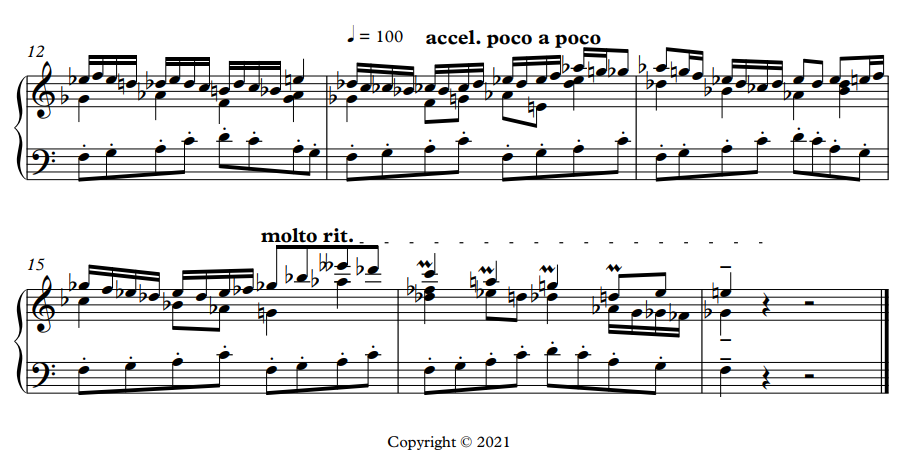
Take, for example, my piece Helium for toy piano, written for Dr. David Bohn as part of his Fifteen Minutes of Fame series with Vox Novus. The piece begins in F major, using only the F major pentatonic scale.

As the music progresses, additional notes are introduced methodically—B♭, E♭, A♭, D♭, and so on—expanding outward (and backwards!) through the circle of fifths. With each new pitch, the harmony becomes increasingly tense. Simultaneously, the tempo increases and a third contrapuntal voice emerges, enriching the texture and pushing the limits of the toy piano’s expressive capabilities.
Distilling a musical idea into such a short form (and keeping the product musically coherent and interesting) is a challenge which draws me to the miniature. Because the musical ideas stem directly from external constraints (i.e., the properties of the particular element being expressed through my cryptographic method) the process remains fresh, surprising, and creatively challenging.
In future posts, I’ll delve into other works in the periodic table series, exploring how different elements have inspired unique musical solutions, and how I have explored different musical ideas I’ve been interested in over time.
 Jason Taurins