Musical Miniatures – Part 2

With the world premiere of my miniature Beryllium for tenor saxophone, in my Elements series, on June 4th at 7:00PM EST (shoutout Drew Hosler, who will be performing my work!). I am making this entry into my series of blog posts about musical miniatures. 

To say the work of Edgard Varese has had an enormous influence on my music is an understatement. I often make subtle references to his music in my compositions. Take the below example from his work Density 21.5 for solo flute. The opening motive, F-E-F# (alternatively, [0,e,1] or any of its permutations) is, in my opinion, a wonderful use of symmetry – reflecting across the pitch-axis of the first note, a half step below and then above that pitch.

Density 21.5 for solo flute, measure 1.

I often use this motive directly in my music. I sometimes use an expanded form, following this pattern through a twelve-tone row.

Reflected across the axis of the first pitch, the tone row expands outward in pairs of semitones.

Other times, I use the idea by taking a musical motive, and repeating it down a semitone, and then up a semitone from the original. Take the following example from Beryllium:

Beryllium, measure 4. The 5-let motive starts on A, then is repeated on G# and Bb.

This technique permeates the whole piece. I also really love the low honks which saxophones are capable of. These are heard throughout the work.

Beryllium, measure 15. This example shows both the Density 21.5 technique, and low honks.

It’s always fun writing for a virtuoso (and new-music specialist!) like Hosler. They always seem to find a way to make difficult passages sound effortless. Hosler will be giving the world premiere performance of the anthropocene extinction for solo baritone saxophone later this year. He also premiered Lithium and Saxharp!

Beryllium, measures 16-19. Techniques used include a multiphonic, low honks, and harmonics from the low register up through the altissimo register.


Musical Miniatures – Part 1

In this series of posts, I plan to discuss the musical ideas that go into my musical miniatures—brief, concentrated works that distill compositional thought into compact forms. These pieces often last only a minute or so, but within that short time, I aim to explore specific ideas in harmony, structure, and texture.

My harmonic language, which leans toward the dissonant and chromatic, is well-suited to this format. Extended stretches of sharp dissonance can be overwhelming in longer pieces, but when confined to miniature form, they can be intense without exhausting the listener. Like Anton Webern, I prefer economy in many of my chamber works. The miniature allows me to say more with less, and to present musical ideas which are both concise and pointed.

One of my favorites to write in this genre has been a series of miniatures based on the periodic table of elements. For several years now, I’ve been composing one piece for each element, using a form of musical cryptography I’ve developed. This technique transforms the element’s name, its atomic number, and select properties into pitch material. From there, I craft the composition—not as a programmatic interpretation of the element, but by allowing the encoded material to generate the piece’s musical identity.

The outcomes can be surprising. Because my system excludes the numbers 10 and 11, the pitches A and A♯ do not appear in number-based material. Likewise, the English alphabet’s uneven letter distribution means some element names yield more tonal clarity, while others result in sharp dissonance. The cryptographic method is a structural constraint that shapes the work in often unexpected directions.

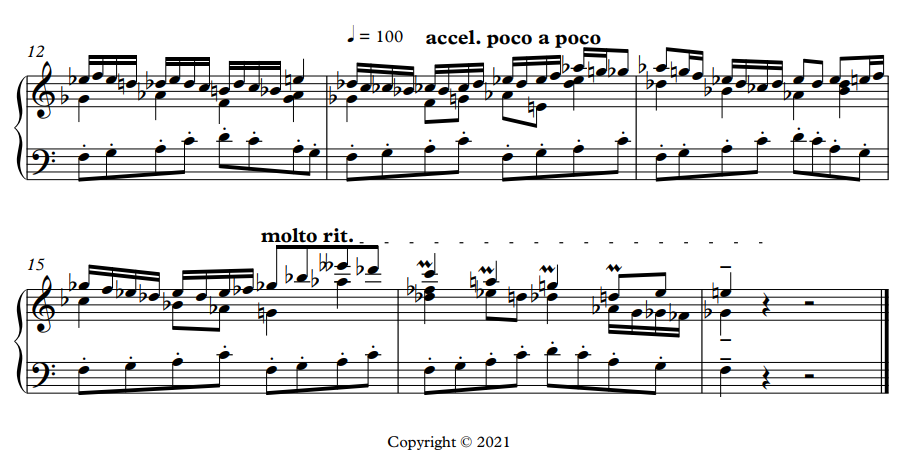
Take, for example, my piece Helium for toy piano, written for Dr. David Bohn as part of his Fifteen Minutes of Fame series with Vox Novus. The piece begins in F major, using only the F major pentatonic scale.

“Helium,” for solo toy piano, opens with the notes of the F major pentatonic scale.

As the music progresses, additional notes are introduced methodically—B♭, E♭, A♭, D♭, and so on—expanding outward (and backwards!) through the circle of fifths. With each new pitch, the harmony becomes increasingly tense. Simultaneously, the tempo increases and a third contrapuntal voice emerges, enriching the texture and pushing the limits of the toy piano’s expressive capabilities.

The music accelerates throughout, and more pitches are added as the piece develops. As such, the music starts out with very consonant counterpoint, and over time becomes increasingly dissonant.

Distilling a musical idea into such a short form (and keeping the product musically coherent and interesting) is a challenge which draws me to the miniature. Because the musical ideas stem directly from external constraints (i.e., the properties of the particular element being expressed through my cryptographic method) the process remains fresh, surprising, and creatively challenging.

In future posts, I’ll delve into other works in the periodic table series, exploring how different elements have inspired unique musical solutions, and how I have explored different musical ideas I’ve been interested in over time.

“Pangrams” Named Finalist in Internation Competition

“Pangrams” (2024) is a brief suite for string orchestra that I recently composed. The idea struck me that a series of miniatures based on the linguistic concept of the pangram – a sentence or verse containing all letters of a language’s alphabet – might yield some interesting results using musical cryptography. Each movement is a short musical cryptogram where the letters of the pangram are converted to musical notes. Containing all letters of the alphabet, the musical equivalent uses all twelve tones; this yielded some surprisingly tonal-sounding musical material to develop. Thus I wrote four movements, totalling about six minutes of music:

I. Sphinx of Black Quartz, Judge My Vow
II. Pack My Box with Five Dozen Liquor Jugs
III. The Quick Brown Fox Jumps Over the Lazy Dog
IV. The Five Boxing Wizards Jump Quickly

The work divides the violin section into four parts, and features the principal players of the violin and cello sections in two of the four movements. It was named a finalist in the “Musica Per Archi” international composition competition, and was premiered by the KLK String Orchestra in Lviv, Ukraine on June 17, 2024.

A Week in the Life #5

Here are some things which have been occupying me musically and personally over the last week.

This week’s post will continue the discussion of techniques in my work Leviathan. Personally, life goes on much as it has. I’m grateful to have lots of time to write and be home with my dogs. The first notes of the #2024saxophoneproject are on the page. There is still time to join! I’m working on this with my composition teacher.

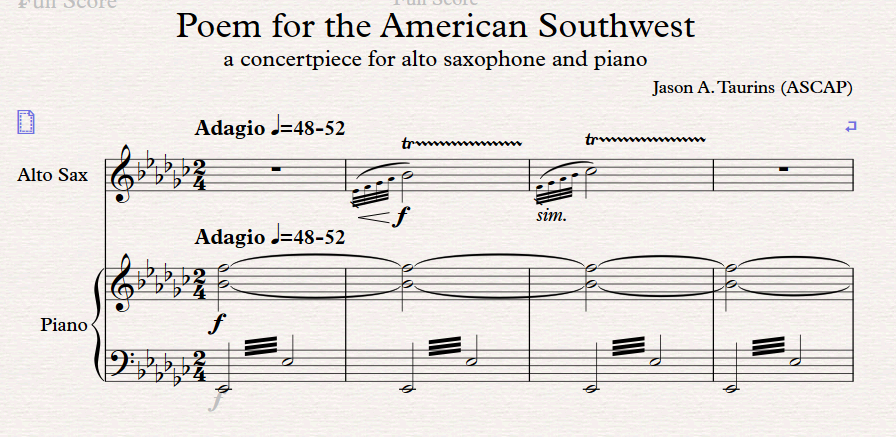
Feel the shimmering heat of the desert southwest? Draft of mm. 1-4 of Poem for the American Southwest.

On with Leviathan (click here for the full recording).

Technique #4 – Extended Techniques
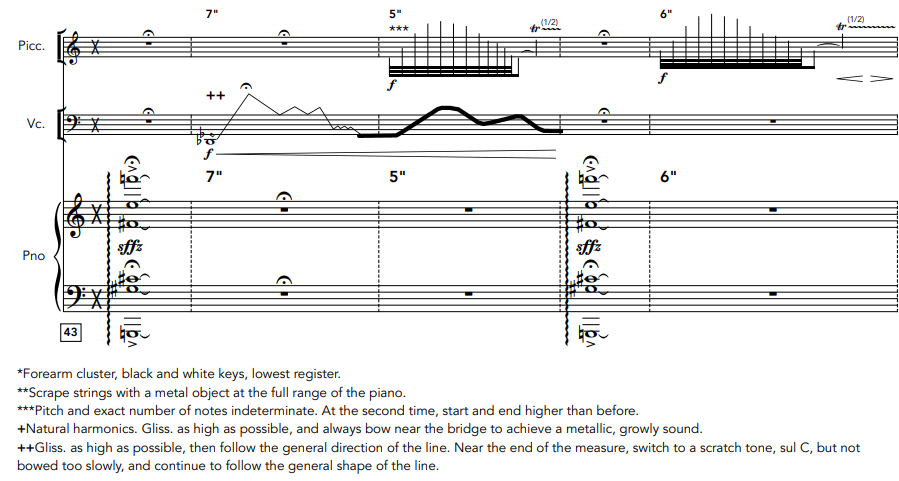
I would hardly be a good modern composer if I didn’t take advantage of the range of sounds which can be performed on the instruments I write for! Just a few from Leviathan include the absence of meter, the use of a metal scraping implement in the piano, indeterminate notation in the piccolo and cello, the use of boxed cells which are freely repeated, forearm and palm clusters in the piano, and alternative bowing techniques for the cello. In the examples below, time is indicated by the number of seconds each bar should last (approximately).

Leviathan, mm. 43-47.
Box notation and free meter, along with piano extended techniques. Leviathan, mm. 48-50.

Technique #5 – Structured Improvisation
Structured improvisation gives a loose framework around which the creativity of the performer takes precedence. In my case, a mix of pre-written and improvised materials make up a significant portion of the work, with solo cadenzas for each instrument, punctuated with violent stabs from the piano.

The third of the cadenzas in Leviathan, mm. 89-96. Brilliantly performed in the premiere recording.

Technique #6 – Collage/Quotation
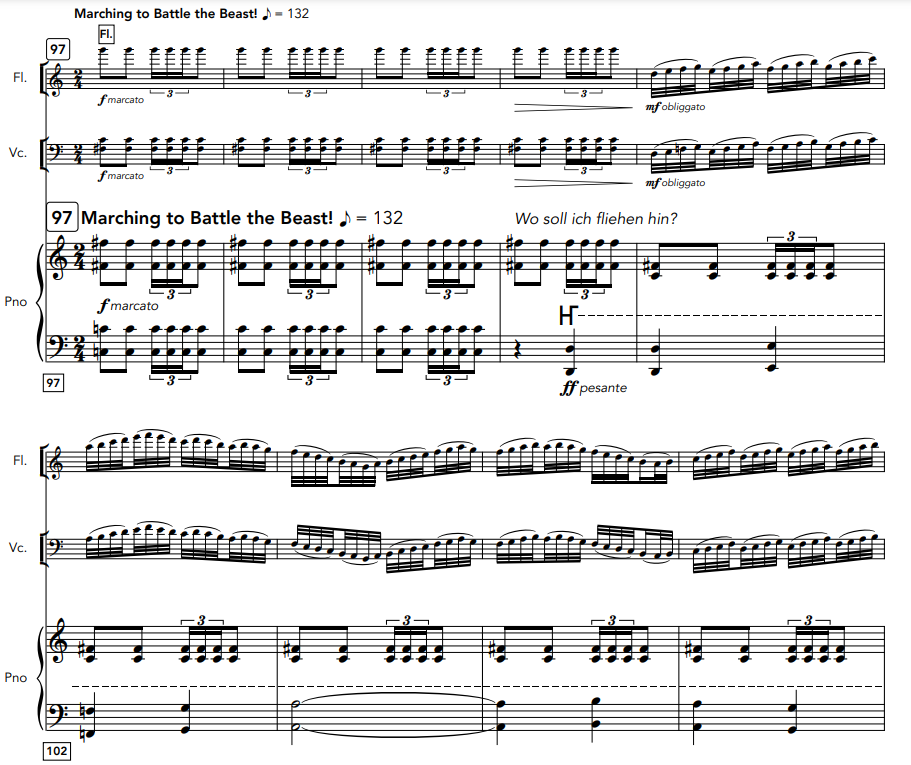
Why do I call my music metamodern? In a sense it is because I use techniques of both modern and postmodern composers with a mix of sincerity and irony. This is a technique used by postmodern composers – mixing in pre-existing music in new and exciting ways. Leviathan ends with quotes of two hymns, one by Bach, the other the familiar Old 100th. The battle march which begins the section is a not-so-subtle not to Holst as well. See if you can find other references hidden in the music (full performance video with score).

Leviathan, mm. 97-105, contains references to Holst and Bach.
Leviathan, mm. 120-122, rhythmically transforms the Old 100th, one of my favorite hymns.

I hope you’ve enjoyed this brief insight into my composing, and thank you/shout out to Josh Trentadue for the fantastic engraving work he did. Check out his website.

Feel free to let me know what you think in the comments!

Written 2/16/24

Processing…
Success! You're on the list.

A Week in the Life #4

Here are some things which have been occupying me musically and personally over the last week.

Personally, there’s not much to report. Life continues much in the way it has for weeks – I’m keeping busy with my day job, and continuing composition lessons. This week instead I will give you a brief overview of some techniques used in Leviathan. I’ll finish the analysis next week. Feel free to follow along with the techniques in the context of the full work:

Technique #1: Rhythmic Dissonance
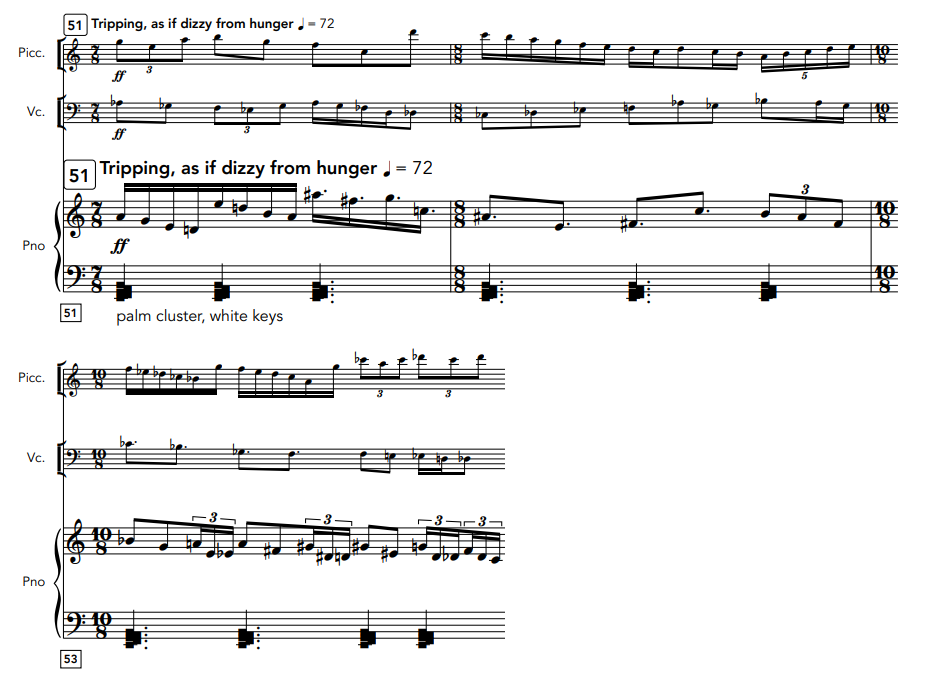
In the opening of Leviathan, I use complex rhythms the way that composers might use dissonance. It’s far from a perfect analogy, but it’s the term I use. Check out the examples below:

Leviathan, mm. 1-6.
Leviathan, mm. 51-53.

Technique #2: Shared Monody
Sharedy monody is a term coined by Joseph Schwantner to describe a melody being split among several instruments. Not all notes of the melody appear in all of the instruments. It’s a way to highlight some notes in a melody, and it kind of blurs the melody out horizontally. In the second example below, the performers are instructed either to speed up (flute), slow down (cello), or maintain the tempo (piano), creating a similar effect.

Leviathan, mm. 7-12.
Leviathan, mm. 60-67.

Technique #3: Dissonant Counterpoint
Of course I didn’t invent the concept or term, but I have my style of it – it essentially reverse the rules of species counterpoint, where dissonant intervals are prefered vertically, and rhythmic dissonance is also used, not unlike a 5th species of counterpoint.

Leviathan, mm. 17-22.

Feel free to let me know what you think in the comments!

Written 2/10/24

Processing…
Success! You're on the list.

A Poem for the American Southwest

the slow arc of the sun
mercury ever rising, rising
above purple mountain skyscrapers

the heat shimmers,
a mirage on the desert floor,
the saguaro stand defiantly

a rural dirt highway
through a ghost town’s ruins
what once was silver is now dust and brick

the monsoon erases
the old day’s haboob,
floods of dirty water bring the desert life

in the highlands now
the sun sets the once piercing blue sky ablaze
soon the Sonoran will come to life

a billion stars shine in the twilight
it is the time of the coyote, the javelina,
underneath the Milky Way

#2024saxophoneproject

A Week in the Life #3

Here are some things which have been occupying me musically and personally over the last week.

This week, I want to talk about a technique which frequently populates my music. When daunted by a blank page, it is one of the first places I go to – musical cryptography. I did not invent the technique, or the term for it, “crypto-serialism,” but I have found some success with it. The essence of the technique is developing a musical chiper to convert strings of characters into musical pitches; a title, concept, name, or line of text or poetry becomes a series of notes.

Below is the cipher I typically use:

There are several good examples of this in the early music of Dr. Neal Endicott, a composer/theorist I met while I was completing my undergraduate work at Western Michigan University. His Boketto for solo flute, riverrun for solo saxophone, and Come Slowly, Eden are a few which come to mind. You can see the conversion of numbers using a similar method in my works in the Elements series of musical miniatures (for example, the properties of Hydrogen and Helium).

The most extensive use in my music can be heard in the recently-released Leviathan. Inspired by the mythological creature as portrayed in the Bible and the cult television series Supernatural, several musical motives and chords are derived from the supposed qualities of the creature.
In the example below, the word “hunger” is converted into pitches. The vertical sonority is based on the letters in order, from the lowest note to the highest.

The Hunger Chord, mm. 57-59, Leviathan.

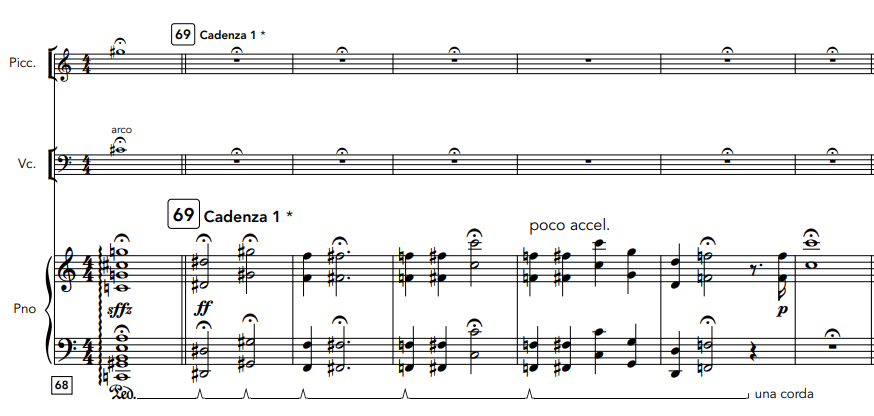
However, the order of the pitches in the vertical sonority aren’t always important, as in the below rendering of the word “Leviathan” (left). The piano spells out in pitches the word “Purgatory,” the mythical home of the creature.

The Leviathan Chord, mm. 68; and Purgatory, spelled out by the piano, mm. 69-74, Leviathan.

There are several creative avenues to explore with this method. These include rhythm, repetition, register, and converting parts of these musical words into musical motives. The possibilities are endless, but it is a definite method of finding where to start! I will use it in the baritone saxophone commission I am working on this year, and will discuss other techniques I use in future blog posts.

Personally, the week was eventful! I worked the state music educators convention; it’s always nice connecting with music educators whom I don’t always get to see, and I was recognized a few times for my music (which is always surreal!). Dark Matter was featured on a reading session, and a set of my music was won in a raffle (I autographed the score for the director!). I’m always grateful for the love and support.

Feel free to share your thoughts in the comments!

Written 2/4/24

Processing…
Success! You're on the list.