I recently read John Green’s new book Everything is Tuberculosis. In this book, he describes the tragically short life of the Japanese poet, Masaoka Shiki. Masaoka, who revived the poetic forms of haiku and tanka in the late nineteenth century, died an agonizing death from tuberculosis in his mid 30s. His poems are both beautiful and haunting, with vivid imagery and rich symbolism.
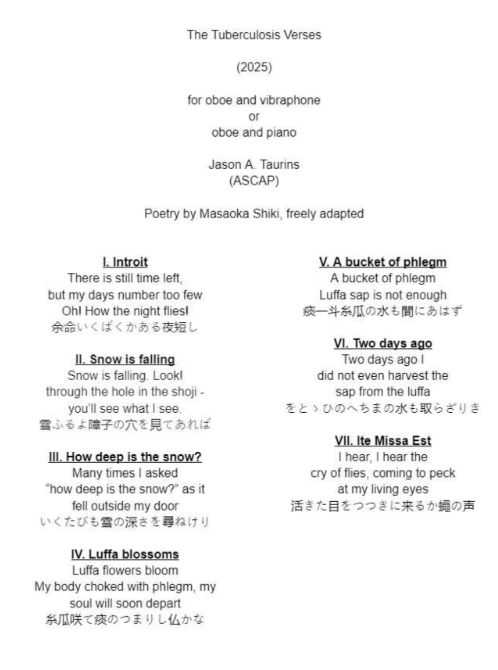
Inspired by both Masaoka and Green, I’ve begun work on a piece for oboe and vibraphone based on Masaoka’s work.
measures 1-3 of movement 1
The seven selected poems feature his despair and suffering, including imagery of snow and luffa plants. Each is being written into a movement of music, with the tentative title The Tuberculosis Verses. I intend the whole work to be about 10 minutes in length. The oboe-vibraphone duo is a beautiful, but unfortunately under-explored, medium in chamber music, and this will be my (first) contribution to the genre.
With the world premiere of my miniature Beryllium for tenor saxophone, in my Elements series, on June 4th at 7:00PM EST (shoutout Drew Hosler, who will be performing my work!). I am making this entry into my series of blog posts about musical miniatures.
To say the work of Edgard Varese has had an enormous influence on my music is an understatement. I often make subtle references to his music in my compositions. Take the below example from his work Density 21.5 for solo flute. The opening motive, F-E-F# (alternatively, [0,e,1] or any of its permutations) is, in my opinion, a wonderful use of symmetry – reflecting across the pitch-axis of the first note, a half step below and then above that pitch.
Density 21.5 for solo flute, measure 1.
I often use this motive directly in my music. I sometimes use an expanded form, following this pattern through a twelve-tone row.
Reflected across the axis of the first pitch, the tone row expands outward in pairs of semitones.
Other times, I use the idea by taking a musical motive, and repeating it down a semitone, and then up a semitone from the original. Take the following example from Beryllium:
Beryllium, measure 4. The 5-let motive starts on A, then is repeated on G# and Bb.
This technique permeates the whole piece. I also really love the low honks which saxophones are capable of. These are heard throughout the work.
Beryllium, measure 15. This example shows both the Density 21.5 technique, and low honks.
It’s always fun writing for a virtuoso (and new-music specialist!) like Hosler. They always seem to find a way to make difficult passages sound effortless. Hosler will be giving the world premiere performance of the anthropocene extinctionfor solo baritone saxophone later this year. He also premiered Lithium and Saxharp!
Beryllium, measures 16-19. Techniques used include a multiphonic, low honks, and harmonics from the low register up through the altissimo register.
In this series of posts, I plan to discuss the musical ideas that go into my musical miniatures—brief, concentrated works that distill compositional thought into compact forms. These pieces often last only a minute or so, but within that short time, I aim to explore specific ideas in harmony, structure, and texture.
My harmonic language, which leans toward the dissonant and chromatic, is well-suited to this format. Extended stretches of sharp dissonance can be overwhelming in longer pieces, but when confined to miniature form, they can be intense without exhausting the listener. Like Anton Webern, I prefer economy in many of my chamber works. The miniature allows me to say more with less, and to present musical ideas which are both concise and pointed.
One of my favorites to write in this genre has been a series of miniatures based on the periodic table of elements. For several years now, I’ve been composing one piece for each element, using a form of musical cryptography I’ve developed. This technique transforms the element’s name, its atomic number, and select properties into pitch material. From there, I craft the composition—not as a programmatic interpretation of the element, but by allowing the encoded material to generate the piece’s musical identity.
The outcomes can be surprising. Because my system excludes the numbers 10 and 11, the pitches A and A♯ do not appear in number-based material. Likewise, the English alphabet’s uneven letter distribution means some element names yield more tonal clarity, while others result in sharp dissonance. The cryptographic method is a structural constraint that shapes the work in often unexpected directions.
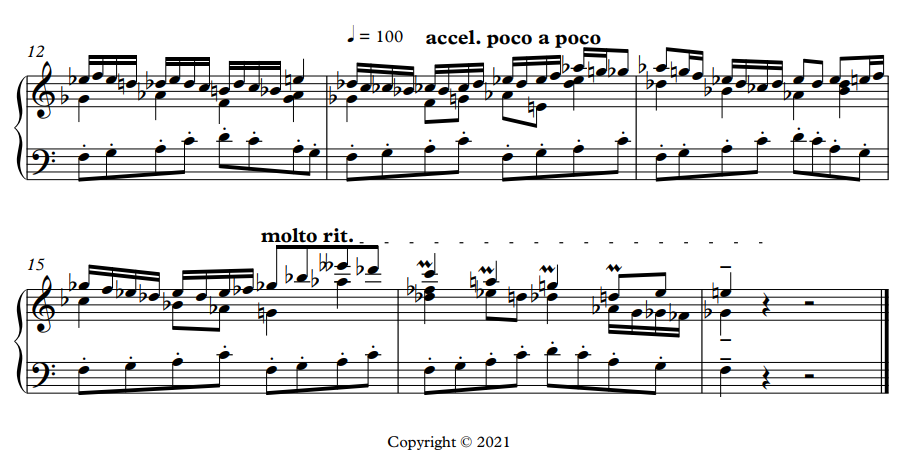
“Helium,” for solo toy piano, opens with the notes of the F major pentatonic scale.
As the music progresses, additional notes are introduced methodically—B♭, E♭, A♭, D♭, and so on—expanding outward (and backwards!) through the circle of fifths. With each new pitch, the harmony becomes increasingly tense. Simultaneously, the tempo increases and a third contrapuntal voice emerges, enriching the texture and pushing the limits of the toy piano’s expressive capabilities.
The music accelerates throughout, and more pitches are added as the piece develops. As such, the music starts out with very consonant counterpoint, and over time becomes increasingly dissonant.
Distilling a musical idea into such a short form (and keeping the product musically coherent and interesting) is a challenge which draws me to the miniature. Because the musical ideas stem directly from external constraints (i.e., the properties of the particular element being expressed through my cryptographic method) the process remains fresh, surprising, and creatively challenging.
In future posts, I’ll delve into other works in the periodic table series, exploring how different elements have inspired unique musical solutions, and how I have explored different musical ideas I’ve been interested in over time.
Here are some things which have been occupying me musically and personally over the last week.
This week, I want to talk about a technique which frequently populates my music. When daunted by a blank page, it is one of the first places I go to – musical cryptography. I did not invent the technique, or the term for it, “crypto-serialism,” but I have found some success with it. The essence of the technique is developing a musical chiper to convert strings of characters into musical pitches; a title, concept, name, or line of text or poetry becomes a series of notes.
Below is the cipher I typically use:
There are several good examples of this in the early music of Dr. Neal Endicott, a composer/theorist I met while I was completing my undergraduate work at Western Michigan University. His Boketto for solo flute, riverrun for solo saxophone, and Come Slowly, Eden are a few which come to mind. You can see the conversion of numbers using a similar method in my works in the Elements series of musical miniatures (for example, the properties of Hydrogen and Helium).
The most extensive use in my music can be heard in the recently-released Leviathan. Inspired by the mythological creature as portrayed in the Bible and the cult television series Supernatural, several musical motives and chords are derived from the supposed qualities of the creature. In the example below, the word “hunger” is converted into pitches. The vertical sonority is based on the letters in order, from the lowest note to the highest.
The Hunger Chord, mm. 57-59, Leviathan.
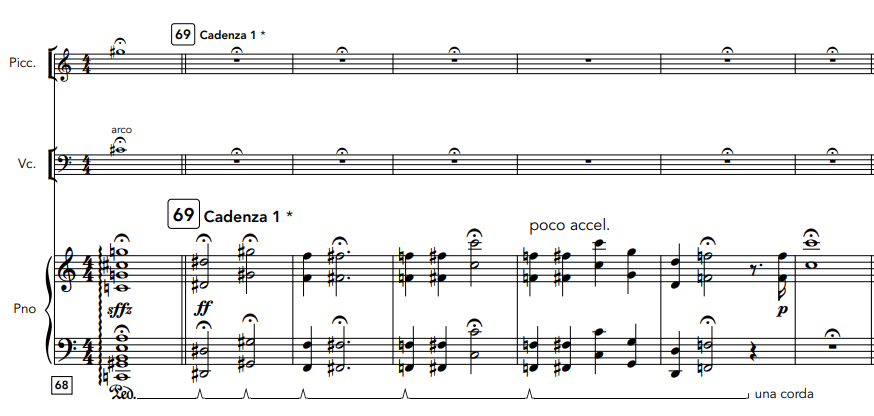
However, the order of the pitches in the vertical sonority aren’t always important, as in the below rendering of the word “Leviathan” (left). The piano spells out in pitches the word “Purgatory,” the mythical home of the creature.
The Leviathan Chord, mm. 68; and Purgatory, spelled out by the piano, mm. 69-74, Leviathan.
There are several creative avenues to explore with this method. These include rhythm, repetition, register, and converting parts of these musical words into musical motives. The possibilities are endless, but it is a definite method of finding where to start! I will use it in the baritone saxophone commission I am working on this year, and will discuss other techniques I use in future blog posts.
Personally, the week was eventful! I worked the state music educators convention; it’s always nice connecting with music educators whom I don’t always get to see, and I was recognized a few times for my music (which is always surreal!). Dark Matter was featured on a reading session, and a set of my music was won in a raffle (I autographed the score for the director!). I’m always grateful for the love and support.
Feel free to share your thoughts in the comments!
Written 2/4/24
Processing…
Success! You're on the list.
Whoops! There was an error and we couldn't process your subscription. Please reload the page and try again.
Here are some things which have been occupying me musically and personally over the last week.
Professionally, I’ve been quite busy. My day job sapped a lot of my energy. But work leads to success, and I’ve set a goal to be better at my day job. I made the Top 10 for sales for the first time this week!
Musically, I’ve been having a lot of fun listening lately. I normally listen to podcasts or audiobooks, just because music is my job, and it’s nice to escape that at times. But I am researching for some big projects, so I’m listening to a ton – music for saxophone, specifically, and chamber music that comes up in my social media/YouTube feeds. I’m enjoying a recent recording of a composition of mine, which was featured on a score video channel (content continues below video):
As far as writing goes…I’m revising a band march I wrote last year, and readying some other scores for sending out to publishers. I’m working on a Christmas-themed piece for band based on my Latvian heritage. And I’m starting my #2024saxophoneproject (details here). And I’m starting to think more like an entrepreneur…especially regarding social media engagement.
Feel free to share your thoughts in the comments!
Posted 1/27/24
Processing…
Success! You're on the list.
Whoops! There was an error and we couldn't process your subscription. Please reload the page and try again.






 Here are some things which have been occupying me musically and personally over the last week.
 Jason Taurins