Let My Song Take Wing (2025/2026)

Let My Song Take Wing for SAB choir is finished, and the score/octavo with the dedication have been sent over to the commissioning ensemble. The world premiere is set for March 10 at Independence High School, in Glendale, AZ. I will be attending some rehearsals in the lead up to the premiere performance, and using student and teacher feedback to make last-minute revisions.

Sending off a commission to the performers for which it was written is both nerve-wracking and satisfying. On the one hand, you’re sending your deeply personal project you’ve been working on, baring your soul and opening yourself up to criticism; on the other, it’s a relief to be done, and to have something out in the world. And there is always time for later revision. In this project, the vocal parts came relatively quickly and easily (and I am grateful to the commissioning director, Katie Sweeney, for her feedback on revisions). The piano part, not so much. My instinct was to simply provide a lead sheet and allow the pianist to improvise accompaniment, but I realize that is not the industry standard. Thank you to Jeff Yoder for your input on the piano writing.

Now for a program note. These are also always daunting to write – you don’t want to include a whole lecture, but adequately help the audience understand the work they’re about to hear.

Let My Song Take Wing is an SAB setting of two poems of Emily Dickinson: I Shall Keep Singing!, and If I Can Stop One Heart From Breaking. I am drawn to the natural imagery of her poetry, and her emphases on nature, spirituality, and death. Much of Dickinson’s poetry follows a relatively common poetic meter, with slant rhyme; in fact, much of her work can be sung to the theme song from the Pokemon animated show. These two poems are exceptions, so I freely adapted the poetry to fit the music I had written, and I added my own lyrics for the bridge.

The song is simple in form – alternating verses and choruses, followed by a bridge, followed by a recap of the chorus and the first verse; this is followed by a fadeout on the line “I shall keep singing!” Each poem takes up one of the verses, and the line “I shall keep singing!” is used in the chorus. The first verse, based on the poem If I can Stop One Heart From Breaking, is about the power of music for healing, and the exercise of one’s faith in service to others. The second, based on the poem I Shall Keep Singing! is about the feeling one is being passed by others, personally, professionally, and artistically. The bridge reminds us to let our song take wing, even if we are the only ones to hear it.

Musically, the piece is inspired by American popular music styles; in particular, the chord progressions following what are, in musical jargon, known as plagal chains. I hope you find the music uplifting and exciting!

Let My Song Take Wing – Choral Commission

Let My Song Take Wing – Choral Commission

I am currently working on a choral commission (SAB voicing) with the Independence High School Choirs, here in Glendale, AZ. Their spring concert theme this school year is music derived from literature, and includes some fun music! This has been a really fun project, and if you’d like to be a part of it, please reach out!

I, of course, am a huge fan of poetry, and in particular have been reading a lot of Emily Dickinson over the last year. I am fascinated by her use of natural imagery and her more existential and romantic poems. I also find it amusing that most of her poems can be sung to the tune of the Pokemon theme song (“Because I could not stop for Death” will never sound quite the same, to me!)!

I have chosen a setting of two of her poems related to art and music. Both “If I can stop one heart from breaking” and “I shall keep singing!” have been set by many composers, and so my goal is to find a way to say something new with both texts – something I think I have successfully done. These poems are of particular interest in Dickinson’s oeuvre: they do not follow the typical metric and rhyme schemes she used. And so, I have freely adapted the text, and added my own to the bridge. The full lyrics, as they are currently, are shown below. 

Verse 1:
If I can stop one heart from breaking,
then I shall not live in vain;
If I can ease one life the aching,
or if I can cool one pain.

Or help one fainting robin
unto his nest again,
then as long as I keep singing,
I shall not sing in vain

Chorus:
I shall keep singing!

Verse 2:

Birds will pass me
on their way to Yellower Climes.
Each, with a Robin’s expectation,
I with my Redbreast and my Rhymes.

When I take my place in summer,
I shall bring a fuller tune.
Vespers are sweeter than Matins,
Morning, the seed of Noon.

Chorus:
I shall keep singing!

Bridge:
So let my song take wing,
beyond the fleeting day,
carried on the quiet air,
where silence melts away!

Chorus:
I shall keep singing!

Verse 1:
If I can stop one heart from breaking,
then I shall not live in vain;
If I can ease one life the aching,
or if I can cool one pain.

Or help one fainting robin
unto his nest again,
then as long as I keep singing,
I shall not sing in vain.

Outro (a capella, repeat ad lib. and fade out):
I shall keep singing!

Musically, the song is in the pops/Broadway style. I very much admire such music, though I rarely write it! 

The music is rhythmically syncopated, with the dotted quarter, dotted quarter, quarter rhythmic motive heard throughout. Many of the musical lines start off of the beat, as well. 

The opening of the first verse, showing the syncopated start to each line of the text.

The music is in F major, and stays in the range of an octave and a fourth (C4-F5 in soprano, C4-C5 in alto, and C3-D4 in baritone), and generally stays within an octave. Leaps and the high registers are used sparingly. There is an optional ad libitum soprano solo. 

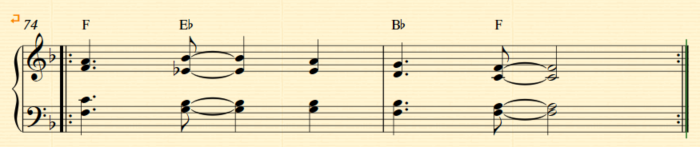
I am also inspired by non-functional harmony and the chord loops heard in many popular genres of music over the last century – particularly those heard in grunge, punk, and pop punk musics. While this music is in none of those styles, the harmonies are derived from those worlds – double suspensions, reverse circle of fifths progressions, etc. For example, an important chord progression in this tune is Fmaj-Ebmaj-Bbmaj-Fmaj. 

The Fmaj-Ebmaj-Bbmaj-Fmaj progression, heard throughout the piece. Beat 4 of m. 74 and beat 1 of m. 75 have passing tones in the upper voice. The sharp 11 over the Ebmaj chord in that voicing is similar to the Viennese Trichord, which is rare in popular musics, but common in mine!

The bass notes of typical tonal harmonic progressions move counterclockwise around the circle of fifths (for example, a ii-V-I in F moves, with bass notes, G-C-F). The progression I use moves clockwise instead – with bass motion of F-Eb-Bb, before returning to F. Because of the bass voice motion in fourths, theorists call this a double plagal cadence; and, it is very common in popular music of the last century. I make extensive use of it in my music.   

The circle of fifths is shown to follow bass note motion either clockwise or counterclockwise.

The bridge uses a very common progression, known as a line cliche. In a line cliche, one voice of a chord moves down in half steps. The others may or may not move around it. It leads nicely to a V7/V – V7 at the end, setting us up for the finale. It’s not how I typically approach writing such sections (I rather like the Sears-Robuck bridge, or some variant of IV-I-V-I-IV-I-V/V-V), but I like the elegant voice leading here.  

An example of the line cliche used, in F major.

Katie Sweeney, the director who is leading this commission, also noted that the beginning of the chorus bears some resemblance to “Free Fallin’” by Tom Petty. I greatly admire his music. 

Katie Sweeney compares this to the opening motive of “Free Fallin'” by Tom Petty. The composer is flattered by the comparison!
