I recently read John Green’s new book Everything is Tuberculosis. In this book, he describes the tragically short life of the Japanese poet, Masaoka Shiki. Masaoka, who revived the poetic forms of haiku and tanka in the late nineteenth century, died an agonizing death from tuberculosis in his mid 30s. His poems are both beautiful and haunting, with vivid imagery and rich symbolism.
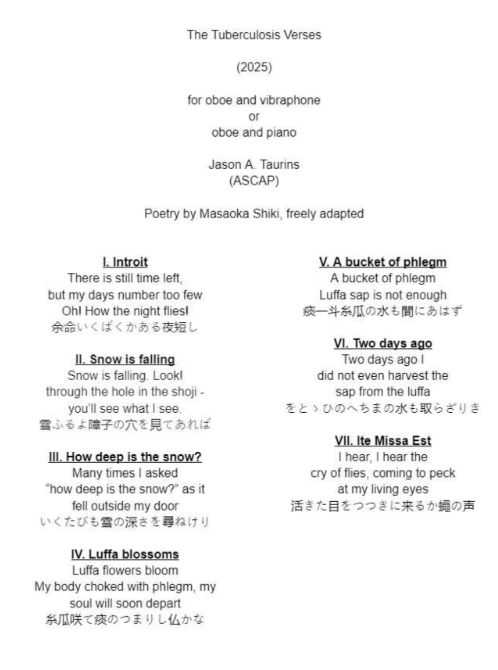
Inspired by both Masaoka and Green, I’ve begun work on a piece for oboe and vibraphone based on Masaoka’s work.
measures 1-3 of movement 1
The seven selected poems feature his despair and suffering, including imagery of snow and luffa plants. Each is being written into a movement of music, with the tentative title The Tuberculosis Verses. I intend the whole work to be about 10 minutes in length. The oboe-vibraphone duo is a beautiful, but unfortunately under-explored, medium in chamber music, and this will be my (first) contribution to the genre.
Here are some things which have been occupying me musically and personally over the last week.
The Busy Season
Musically, it is the busy season! Publishers are putting out their new catalogs, and starting to accept new works. In that vein, I have one band (I’ll expand on that one below) and one strings work in progress. It is also marching band season, and I have two marching shows I am arranging – one with a theme of celebrating Chicano music and culture; and the other with a weather theme. I am learning a ton about writing for battery and front ensemble; integrating work with other folks, who choreograph the shows, and my contractor for writing percussion parts; and even some styles for arranging jazz, a la Basie.
I recently read John Green’s new book “Everything is Tuberculosis.” In this book, he describes the tragically short life of the Japanese poet, Masaoka Shiki. Shiki, who revived the poetic forms of haiku and tanka in the late nineteenth century, died an agonizing death from tuberculosis in his mid 30s. His poems are both beautiful and haunting, with vivid imagery and rich symbolism.
Inspired by both Shiki and Green, I’ve begun work on a piece for oboe and vibraphone based on Shiki’s work. The seven selected poems feature his despair and suffering, including imagery of snow and luffa plants. Each is being written into a movement of music, with the tentative title “The Tuberculosis Verses.” I intend the whole work to be about 10 minutes in length. The oboe-vibraphone duo is a beautiful, but unfortunately under-explored, medium in chamber music, and this will be my (first) contribution to the genre. If you’re interested in joining the project, or know of someone who would be, please reach out!
Sonemoia– a neologism
The band work in progress, with the tentative title “Petroglyphs,” will be about a grade 1 to 1.5 work which is somber in nature. Inspired by petroglyphs found in Arizona, and those I viewed recently in Joshua Tree National Park, I found myself lacking the words to describe precisely the emotions I felt viewing these artifacts from 2000 years ago. “The Dictionary of Obscure Sorrows,” penned by neologist John Koenig, offers two words which are close – sonder and anemoia.
Sonder is the feeling that everyone around you lives a life as rich and complex as your own, that you can never truly know. Everyone, including the stranger you pass on the street and the person that lives on the other side of the planet, lives a life full of love, hope, grief, regret, and the rest of the full spectrum of what it means to be human – they work hard, love their friends and family, and do the best they can. It’s a profound feeling, and it reminds us we have more in common with everyone than we think. Indeed, the world might be a nicer place if we all remembered to imagine each other complexly.
Anemoia is nostalgia for a time one can never know. I certainly felt this when seeing the Joshua Tree petroglyphs, but the feeling was more complex. As I stood before the petroglyphs, I was struck not just by the artistic marks themselves, but by the people behind them. Their joys, fears, dreams, and disappointments are lost to time, but their marks remain—silent yet deeply human. As we are separated by time, I wonder what stories, jokes, and music their culture might have had, and in some sense feel a sense of loss that these are all lost to time. And I wonder what from our time will be lost to future generations.
So with the help of ChatGPT, I coined a new word: sonemoia. A portmanteau of sonder and anemoia, sonemoia represents the wistful, aching awareness that others—whether distant in geography or history—have lived lives as real as ours, full of laughter, sorrow, and longing. It is the grief of never knowing their stories, and the hope that our own will one day be seen with the same reverence. In a world that too often flattens others into enemies or footnotes, sonemoia is a call to imagine more deeply, feel more widely, and remember more kindly.



 Jason Taurins