
Here are some things which have been occupying me musically and personally over the last week.
Personally, there’s not much to report. Life continues much in the way it has for weeks – I’m keeping busy with my day job, and continuing composition lessons. This week instead I will give you a brief overview of some techniques used in Leviathan. I’ll finish the analysis next week. Feel free to follow along with the techniques in the context of the full work:
Technique #1: Rhythmic Dissonance
In the opening of Leviathan, I use complex rhythms the way that composers might use dissonance. It’s far from a perfect analogy, but it’s the term I use. Check out the examples below:

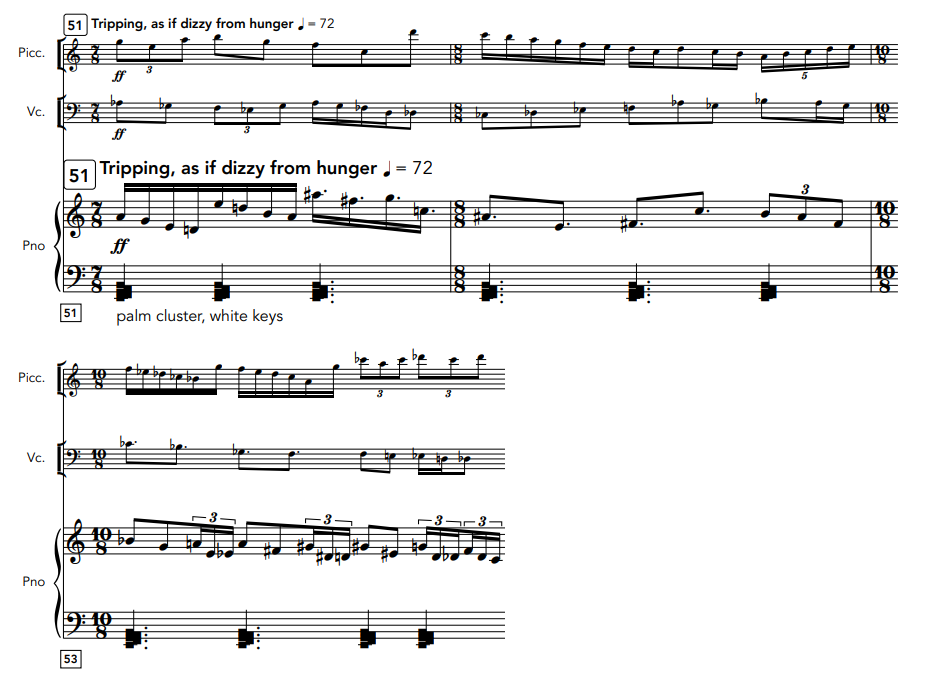
Technique #2: Shared Monody
Sharedy monody is a term coined by Joseph Schwantner to describe a melody being split among several instruments. Not all notes of the melody appear in all of the instruments. It’s a way to highlight some notes in a melody, and it kind of blurs the melody out horizontally. In the second example below, the performers are instructed either to speed up (flute), slow down (cello), or maintain the tempo (piano), creating a similar effect.


Technique #3: Dissonant Counterpoint
Of course I didn’t invent the concept or term, but I have my style of it – it essentially reverse the rules of species counterpoint, where dissonant intervals are prefered vertically, and rhythmic dissonance is also used, not unlike a 5th species of counterpoint.

Feel free to let me know what you think in the comments!
Written 2/10/24
 Jason Taurins